We are currently closed while we propagate and grow plants for fall.
We’ll reopen on October 1 for the next planting season
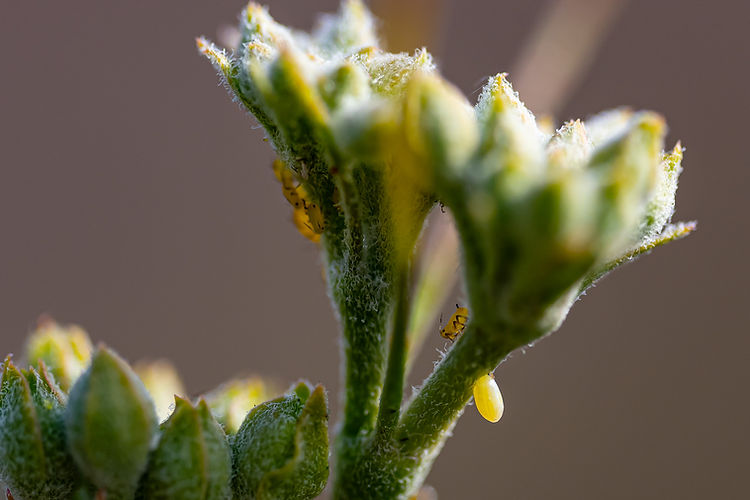
Monarch Larva Monitoring Project at DesertStrawHouse
More Than Counting Monarchs
The Monarch Larva Monitoring Project (MLMP) is a standardized community science program founded in 1997 by Dr. Karen Oberhauser. Beginning with just 25 monitoring sites, the program now includes more than 1,000 sites across North America. By following the same monitoring protocol, volunteers collect standardized observations that allow researchers to compare monarch density throughout the season, between years, and among monitoring sites across North America.
Each monitoring site begins with an annual milkweed census to document the number of milkweed plants available. Throughout the breeding season, volunteers examine those plants each week, recording monarch eggs, caterpillars, chrysalises, and adults. These observations are used to calculate monarch density per milkweed plant, allowing scientists to compare populations within a season, between years, and among monitoring sites.

At DesertStrawHouse, we collect all of the standard MLMP observations while expanding our monitoring to include queen butterflies, other insects associated with milkweed, plant condition, flowering, nectar availability, weather, disturbance, and other ecological observations. MLMP provides the standardized foundation. Our additional observations help us ask questions specific to the Colorado Desert ecosystem.
As our monitoring program develops, we continue adding environmental observations, such as sun exposure and weather conditions, that may help explain patterns we see in the field and how monarchs, queens, and other insects use native milkweed.
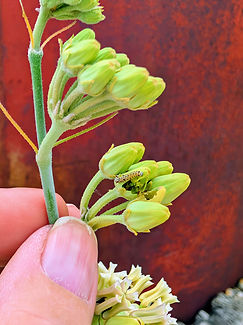
A second instar monarch caterpillar feeding among rush milkweed flower buds. At this stage, they're easy to overlook without careful observation.
Our Monitoring Sites
DesertStrawHouse monitors native milkweed in two very different settings.
Demonstration Gardens
Established wildlife habitat demonstrating how native milkweeds function within a healthy wildlife garden.
Nursery
Container-grown native milkweeds used for propagation, education, and research.
Monitoring both sites allows us to compare how different habitats support monarchs, queens, and the many other insects that depend on native milkweed.
Monitoring the Milkweed Ecosystem
During each monitoring session, we record monarch eggs, caterpillars, chrysalises, and adults using MLMP protocols. In addition to the required MLMP observations, we document queen butterflies and observe the many other insects that share native milkweed, including pollinators, predators, parasitoids, herbivores, and other wildlife.
We also record weather, disturbance, nectar availability, and other observations that help us better understand how the milkweed ecosystem changes throughout the season.
Every milkweed plant tells a story. Rather than focusing on a single species, we look at the entire community that depends on these remarkable native plants. Because we monitor throughout the year, we can also document how this community changes with the seasons, even when monarch activity is low.
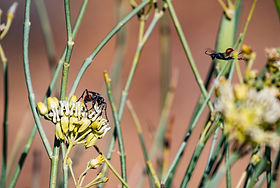
Wasps – hunting, nectaring, or searching within the habitat.
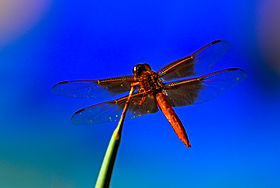
Dragonfly – using the plant as a hunting perch.
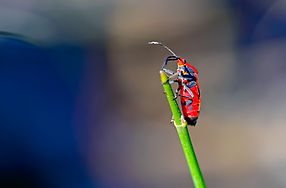
Large Milkweed Bug – feeding on the plant.

Leafhopper – using the plant as food and shelter.
Milkweed supports far more than monarch butterflies.
Why Monitor Queens?

Although the Monarch Larva Monitoring Project focuses on monarch butterflies, queen butterflies are an important part of our local ecosystem.
Because queens and monarchs share many of the same native milkweed species in the Coachella Valley, documenting both provides a more complete picture of how these butterflies use our habitat throughout the year.
Monitoring both species also helps us better understand seasonal patterns and the interactions occurring within the desert milkweed ecosystem.
Year-Round Monitoring in the Colorado Desert
Most Monarch Larva Monitoring Project sites monitor during a relatively short breeding season.
The Coachella Valley is different. Our native Rush Milkweed (Asclepias subulata) remains green throughout the year, providing a potential host plant even when monarchs are not expected. Because of this, DesertStrawHouse monitors year-round. While monarch activity is concentrated from fall through spring, occasional summer monarch sightings have been documented, making year-round monitoring important

J F M A M J J A S O N D
🦋 Monarchs
👑 Queens
🌿 Rush Milkweed
Typical timing. Seasonal activity may shift slightly depending on weather.
Why Community Science Matters
Long-term conservation depends on long-term observations. In the wild, monarch survival has always been low. Only about 2–5% of monarch eggs survive to become adult butterflies. Although we know monarchs face incredible challenges throughout their range, we don't always know exactly how those challenges play out in the Colorado Desert
Nature was never designed for every monarch to survive. It was designed for enough of them to survive.

A monarch caterpillar parasitized by a wasp. Not every caterpillar survives, and documenting these interactions is part of understanding the ecosystem.

By following the same milkweed plants week after week, year after year, we can better understand how these natural processes shape monarch populations in the Colorado Desert and recognize when human-caused pressures may be changing the balance.
That's why we monitor predators, parasitoids, plant condition, weather, and the entire milkweed ecosystem, not just monarchs.
Each weekly monitoring session contributes another piece to a much larger picture. Over time, these observations help researchers better understand monarch populations while allowing us to learn more about the unique ecology of native milkweed in the Colorado Desert.
Become a Volunteer
The Monarch Larva Monitoring Project at DesertStrawHouse is entirely volunteer-run.
Every observation is made by people who generously donate their time because they care about monarch conservation and our desert ecosystems.
As more volunteers become involved, so can the program. Additional volunteers will allow us to expand our monitoring efforts, pursue monarch tagging opportunities, spend more time interpreting and sharing what we're learning, and continue building a better understanding of the milkweed ecosystem.
No experience is necessary. We provide training, and volunteers of all experience levels are welcome.
Interested in joining us?
We'd love to hear from you. Contact us to learn about current volunteer opportunities and monitoring days.