We are currently closed while we propagate and grow plants for fall.
We’ll reopen on October 1 for the next planting season

Threats to Monarchs
Nature isn't supposed to be easy.
Very few plants or animals survive to adulthood. Predators, parasites, disease, weather, competition, and limited resources have shaped monarchs over millions of years. These natural challenges are not the problem. They are part of a healthy ecosystem and help produce resilient wild populations.
Our role isn't to remove those natural challenges. It's to stop adding new ones. Habitat loss, pesticides, climate change, and other human-caused pressures are making an already difficult life cycle even harder.
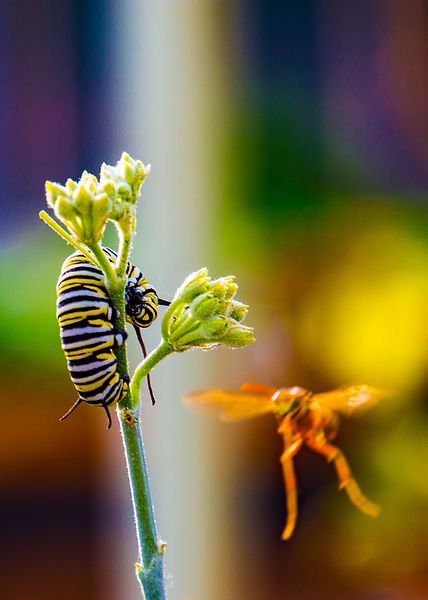
Life on a milkweed plant is rarely quiet. Monarch caterpillars share milkweed with predators, parasites, pollinators, and countless other insects.
Population Trends
Ongoing monitoring at overwintering sites allows scientists to estimate the size of monarch populations and track long-term trends over time.
In the 1990s, an estimated more than 700 million eastern monarchs migrated to Mexico each winter, while more than one million western monarchs overwintered along the California coast.
Today, the eastern migratory population has declined by approximately 80% since the 1980s. The western population has declined by more than 95%. Although monarch numbers naturally fluctuate from year to year, and occasional rebounds demonstrate that the species can respond when conditions improve, the long-term trend for both populations remains sharply downward.
This tells us that protecting and restoring habitat works, but much more habitat is needed if these populations are to recover over the long term.
Federal Protection
In December 2024, the U.S. Fish and Wildlife Service proposed listing the monarch butterfly as a threatened species under the Endangered Species Act. Because the regulatory process is ongoing, we encourage readers to visit the U.S. Fish and Wildlife Service for the most current status.
Western Monarch Population 1990s 🦋🦋🦋🦋🦋🦋🦋🦋🦋🦋
Today 🦋 >95% decline
Human-Caused Challenges
Habitat Loss
-
The loss of milkweed is one of the most significant factors driving the plunge in monarch numbers.
-
The increased use of herbicides has reduced the abundance of milkweed and nectar plants.
-
The widespread adoption of herbicide-resistant corn and soybeans has resulted in the loss of more than 100 million acres of monarch habitat in recent years.
-
Clearing, mowing, and spraying roadsides contribute to the loss of habitat.
Our ever-expanding urban sprawl threatens monarch habitats as well as the planting and spread of invasive plants like fountain grass, stinknet, and sahara mustard.
The monarch butterfly's overwintering sites in Mexico face threats from illegal logging. This logging disrupts the delicate forest microclimate that the butterflies depend on for survival. Meanwhile, on the California coast, development and poor land management practices have destroyed or degraded many areas where monarchs once thrived during the breeding season.

Insecticide
We have become accustomed to expecting perfect, insect-free plants. Nurseries and growers respond to that expectation by treating plants for pests. If we want gardens that support insects, we also need to rethink what a healthy plant looks like. A few chewed leaves or signs of insect activity aren't necessarily a problem. They may be evidence that the habitat is doing exactly what we created it to do.
Neonicotinoids, commonly called neonics, are of particular concern because they are systemic insecticides. They are absorbed by the plant and can remain in its tissues, including leaves, pollen and nectar. Caterpillars can be exposed as they eat treated leaves, while adult butterflies and other pollinators may be exposed as they feed on nectar.
At sufficient doses, neonicotinoids can kill monarchs, other pollinators and invertebrates. Lower doses may cause sublethal effects that affect survival, development, behavior and reproduction.

Do not use insecticides in or around your pollinator habitat. Natural or organic does not mean harmless. Organic pesticides can also kill or injure monarchs, native bees and other beneficial insects.
If a pesticide must be used elsewhere on your property, carefully read and follow the label and take precautions to prevent drift into your habitat. In the Coachella Valley, evening generally provides the longest window before most daytime pollinators become active again. But there is no victim-free time to spray. Some native bees sleep in flowers and vegetation at night, and other beneficial insects are active after dark. The goal is to avoid pesticides whenever possible and minimize harm when their use is unavoidable.

When purchasing plants:
It is always a good practice to ask whether the plants you are buying have been treated with insecticides, either at the nursery or by the grower. If they have been treated, or if the nursery does not know their treatment history, we recommend not buying them for your pollinator habitat.
Climate Change
It is not fully possible to predict the impacts of climate change, but we do know climate change threatens monarchs in several ways.
-
Frequent episodes of extreme weather harm the overwintering butterflies clustering in trees for protection against rain and wind.
-
Warmer temperatures may increase the abundance or expand the ranges of some insects, including invasive species. This may in turn lead to increased pesticide use, which would be detrimental to all wildlife, not just monarchs.
-
Rising temperatures affect monarchs in complex ways. While warmer temperatures within a suitable range can speed caterpillar development, extreme heat reduces survival and alters behavior.
-
Recent research has shown that caterpillars escaping predators by dropping from milkweed may face lethal temperatures on the ground during extreme heat events. Climate change may therefore increase mortality both directly and indirectly.
-
Drought in California and other western states reduces milkweed and nectar plants in the west.
-
Climate change also threatens the trees at monarch overwintering sites.
-
While some effects, like potential range expansion for some plants, are unclear, the overall impact is likely negative.
Our ever-expanding urban sprawl threatens monarch habitats as well as the planting and spread of invasive plants like fountain grass, stinknet, and sahara mustard.
The monarch butterfly's overwintering sites in Mexico face threats from illegal logging. This logging disrupts the delicate forest microclimate that the butterflies depend on for survival. Meanwhile, on the California coast, development and poor land management practices have destroyed or degraded many areas where monarchs once thrived during the breeding season.

Natural Challenges
Even under ideal conditions, monarch survival is naturally low. In the wild, only about 2–5% of monarch eggs survive to become adult butterflies. Predators, parasites, disease, and weather have always been part of the monarch's life cycle.
Though the impact of predators on monarchs is poorly understood, researchers believe predation is an increasing problem, especially due to the spread of non-native species such as the red imported fire ant (Solenopsis invicta).
The protozoan parasite Ophryocystis elektroscirrha (OE) is an additional concern, particularly where non-native tropical milkweed is planted. Although OE has become an important conservation issue in many parts of California, it does not currently appear to be a major concern in the hot, dry climate of the Coachella Valley. We recommend planting locally native milkweeds because they support the broader Colorado Desert ecosystem.


This is one reason monarchs are such an important indicator species. Monarchs have evolved to survive the natural challenges of life in the wild. When a widespread, adaptable species begins declining across much of its range despite those natural adaptations, it tells us something has changed in the ecosystems they depend on. Their decline signals that the ecosystems supporting monarchs are also becoming less healthy for countless other plants and animals.
When people think about monarch conservation, it's easy to focus on saving individual butterflies. Healthy populations, however, depend on healthy ecosystems. The most effective conservation efforts restore habitat and allow natural ecological processes to function. When we create habitat for monarchs, we also create habitat for countless other species that share the same ecosystem.